
Land Clearing Contractors in Austin, TX
Serving acreage owners, builders, and ranch managers on both sides of the Balcones Escarpment — from the cedar-choked hills off Loop 360 and RM 620 to the open prairie ground out toward Manor and Del Valle.
An owner walks every property before we quote it. Free estimates, Monday through Saturday.
30+ Years
Combined Owner Experience in Clearing, Excavation & Forestry
Licensed & Insured
USDA and NRCS Grant Projects Supported
Free Estimates
An Owner Walks Every Property
50+ Projects
Completed in the Austin Area
Land Clearing Services in Austin, TX — Built for This Ground
Austin is a city split down the middle by geology. The Balcones Escarpment runs roughly north to south through town, close enough to I-35 that locals use the highway as shorthand for the divide. West of it, you are on the Edwards Plateau: rugged limestone hills, soil so thin it barely covers the rock, spring-fed creeks cutting through canyons, and Ashe juniper crowding live oaks off their own root space. East of it, the Blackland Prairie flattens out into deep black clay that swells after rain and cracks open in drought. Zilker Park sits nearly on the seam — Barton Springs pushes water out of the Edwards Aquifer within sight of ground that behaves nothing like the ground two miles east.
That divide changes the entire approach to clearing a property. On the plateau side, around Westlake, Barton Creek, Steiner Ranch, and out along RM 2222 and RM 620, cedar comes back fast and there is often more rock than dirt within a couple of feet of the surface — which is why forestry mulching and stone crushing get more done here than a dozer and a burn pile ever will. East of I-35, out past US-290 and along the SH-130 corridor through Manor, Hornsby Bend, and Del Valle, the job is different: mesquite and huisache reclaiming old pasture, heavy clay that turns to soup in a Flash Flood Alley downpour, and fence lines that disappear under brush every other season. Austin has been the fastest-growing large metro in the country, and that growth has pushed buyers onto raw acreage on both sides of the line.
Crosscut works out of Bertram, about an hour northwest of downtown Austin up US-183 and SH-29, and Austin has been core territory since Christian Carter and Jordan LaVine started the company. Christian spent 15 years running machines and fighting wildland fire for the federal government before this; Jordan brought 30 years across construction, excavation, and forestry. Between them they have opened build sites in the hills west of MoPac, pulled cedar off oaks on acreage toward Dripping Springs and Driftwood, and mulched overgrown pasture on the prairie side. One of them walks every property before a number is put on paper. Learn more about Crosscutat our about page

Our Land Clearing & Land Services in Austin, TX
Every service Crosscut offers across Central Texas is available on Austin-area properties, on both sides of the escarpment. The equipment that goes to a job depends entirely on what the ground is doing — which is why an owner walks the property first.
Land Clearing in Austin, TX
Full clearing takes a property from unusable to buildable. On Austin acreage that usually means dense Ashe juniper and undergrowth on the plateau side or reclaimed mesquite pasture east of I-35, and the right answer is rarely to take everything down. We remove brush, invasive growth, and unwanted trees while protecting the mature live oaks and native features worth keeping. Crews handle everything from a wooded homesite lot near Bee Cave to several hundred acres out past Manor.
Services include:
- Complete clearing
- Large acreage land clearing
- Brush and underbrush removal
- Homesite and build site preparation
- Tree removal
- Lot clearing
Forestry Mulching in Austin, TX
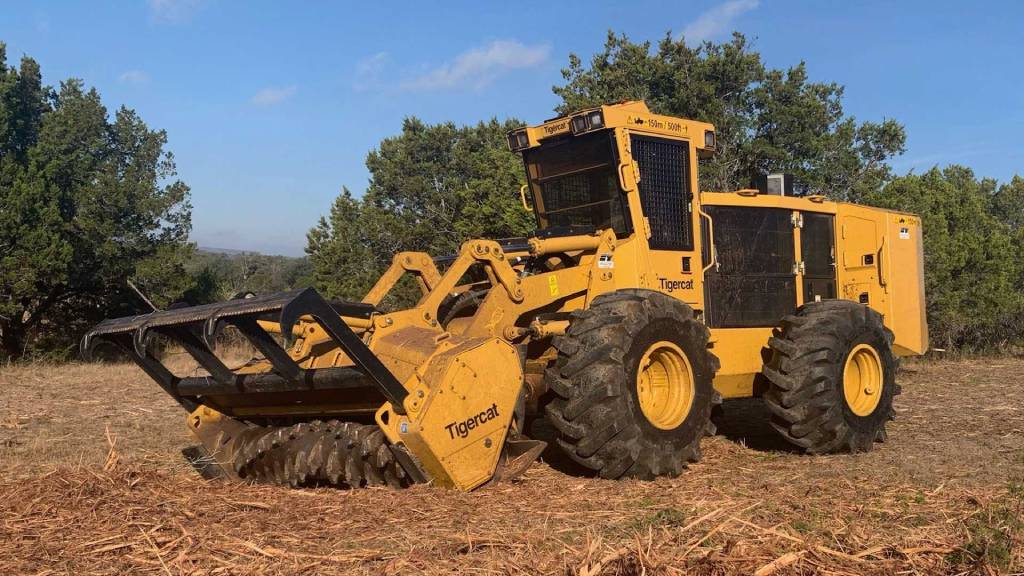
Forestry mulching is what Crosscut does best, and it suits Austin ground particularly well. The material gets ground in place and left as a mulch layer, which holds moisture in thin plateau soil, cuts erosion on the slopes above Bull Creek and Barton Creek, and keeps the topsoil where it belongs instead of washing downhill. There is no burn window to wait on and no debris to haul off. The Tigercat M726G pushes 400 horsepower to a nine-foot mulching head and averages three to five acres a day in dense material, up to ten in lighter growth.
Services include:
- Forestry mulching
- Cedar and underbrush mulching
- Brush mulching
- Vegetation mulching
- Mosaic cutting
- Sloped clearing
Selective Clearing in Austin, TX
Most Austin-area landowners do not want a bare lot. They want the cedar gone and the oaks left standing. Selective clearing is the surgical version of the work — we mark what stays, take out what competes, and open up the canopy without stripping the property. This matters more inside Austin than almost anywhere else in Central Texas, because the city protects trees at 19 inches diameter and protects listed species like live oak at 24 inches outright. Knowing which trees you cannot touch is part of the job.
Services include:
- Selective tree removal
- Cedar removal around protected oaks
- Canopy and line-of-sight opening
- Hunting line of sight
- Mosaic cutting
Cedar Mulching & Removal in Austin, TX
Ashe juniper is the tree Austin loves to hate — it drinks water the oaks need, it drives cedar fever every winter, and on the plateau side it will take a pasture back in a decade. We mulch it in place rather than pile and burn. One important caution specific to this area: mature Ashe juniper in juniper-oak woodland is the only nesting material the endangered golden-cheeked warbler uses, and habitat is federally protected year-round. We check jurisdiction and habitat status before a machine moves.
Services include:
- Cedar mulching
- Cedar removal and thinning
- Liberating oaks from cedar competition
- Regrowth management
- Fence row cedar clearing
Mesquite Grubbing in Austin, TX
Mesquite is mostly an east-of-I-35 problem in this market — old grazing ground out toward Webberville, Garfield, and Elgin that has been left alone long enough for it to take hold. Cutting mesquite off at the ground does not work; it comes back from the root. Grubbing pulls the root ball, which is the only version of this job that lasts. On Blackland clay we time the work around moisture, because the same ground that grubs cleanly in fall turns into a rutted mess after a wet spring.
Services include:
- Mesquite grubbing and root removal
- Huisache removal
- Pasture reclamation
- Regrowth prevention
Pasture Restoration in Austin, TX
A lot of Austin-area acreage was pasture before it was anything else, and much of it is recoverable. We clear the encroaching brush, open the ground back up, and restore grazing and hay production on properties that have been sitting idle. This comes up constantly in unincorporated Travis County, where landowners are working to hold or regain an agricultural valuation. Crosscut also supports USDA and NRCS grant projects, which is often how this work gets funded.
Services include:
- Pasture and rangeland reclamation
- Brush encroachment removal
- Grazing land restoration
- USDA and NRCS grant project support
- Invasive vegetation removal
Wildlife & Land Planning in Austin, TX
Clearing is a habitat decision as much as a land decision, and around Austin that is unusually true. Travis County holds over 33,000 acres of protected land in the Balcones Canyonlands Preserve, and properties adjoining or near it carry real habitat considerations. We plan cuts that improve browse, open sight lines, create edge and travel corridors, and leave cover where it does the most good — whether the goal is a hunting property, a recreational tract, or a conservation-minded homestead.
Services include:
- Wildlife habitat planning
- Hunting line of sight
- Browse improvement and edge creation
- Food plot and trail preparation
- Trail mulching
- Conservation-minded selective cutting
Fence Line Clearing in Austin, TX
Brush eats fence lines fast in this climate, and a buried fence is a fence you cannot inspect, repair, or keep livestock behind. We clear and mulch fence rows clean so the line is walkable and the posts are visible again. On east Austin properties where mesquite and huisache push through from both sides, and on hill properties where cedar leans in over the wire, this is a job worth doing on a cycle rather than waiting until the fence fails.
Services include:
- Fence line and fence row clearing
- Fence row mulching
- Property boundary clearing
- Right of way mulching
- Access lane clearing
Pond Building, Excavation & Digging in Austin, TX
Water is the long game on Central Texas property. We build and rework stock ponds and tanks, dig, and handle general excavation on Austin-area acreage. Site conditions vary sharply here: on the Blackland Prairie east of I-35 the heavy clay holds water well and makes for good pond ground, while on the Edwards Plateau you are usually working around fractured limestone and shallow rock, which changes both the design and the equipment. That assessment happens on the site visit, not over the phone.
Services include:
- Pond and stock tank building
- Existing pond cleanout and reshaping
- General excavation and digging
- Drainage and water management work
- Site prep and grading
Stone Crushing & Rocky Ground Breaking in Austin, TX
West of the escarpment, the problem usually is not the trees — it is the rock. Edwards Plateau limestone sits close enough to the surface across west and northwest Austin that a driveway, a pad, or a utility run hits stone almost immediately. We break and crush rocky ground in place, turning surface limestone and caliche into usable base material rather than trucking spoil off the property and aggregate back on. On properties around Loop 360, RM 2222, and out toward Lakeway and Bee Cave, this is frequently the step that makes the rest of the project possible.
Services include:
- Stone crushing in place
- Rocky ground breaking
- Caliche and limestone processing
- Base material generation
- Pad and driveway preparation
- Grading and site prep
Gravel Roads, Driveways & Culvert Installation in Austin, TX
Access has to survive the weather, and Central Texas weather does not negotiate. We build gravel roads and driveways and install culverts on Austin-area acreage, with the crossings sized for the way water actually moves through this region. Flash Flood Alley is not a marketing phrase — creeks like Onion Creek and Slaughter Creek can move serious water in an hour, and a driveway crossing that was fine for three years can wash out in one storm. Rock crushed on site frequently becomes the base for the road, which keeps material costs down.
Services include:
- Gravel road construction
- Driveway installation and rebuild
- Culvert installation and sizing
- Low water crossing work
- Drainage and erosion control
- Base material placement
Farm & Ranch Road Maintenance in Austin, TX
Interior ranch roads take a beating out here — thin soil over rock washes out on the plateau side, and clay ruts deep and holds it on the prairie side. We grade, reshape, re-rock, and maintain farm and ranch roads so equipment, trailers, and emergency vehicles can get where they need to go year round. On larger Travis County tracts, keeping the interior road network sound is often what makes the rest of the property usable at all.
Services include:
- Ranch road grading and reshaping
- Road base repair and re-rocking
- Washout and rut repair
- Interior access road maintenance
- Culvert and drainage upkeep
Not sure which approach your Austin property needs?
Local Expertise in Austin — We Know This Ground
You cannot quote an Austin clearing job accurately without knowing which side of the Balcones Escarpment the property sits on. West of it, the Edwards Plateau gives you a few inches of soil over solid limestone, slopes that shed water fast, and cedar that regenerates faster than almost anything else in the state. East of it, the Blackland Prairie is deep expansive clay that swells when it rains and shrinks hard in drought — excellent farm ground, and completely different to work. The fault zone dropped the eastern side by as much as 700 feet, and that ancient movement still dictates what your machine hits at eighteen inches down. Properties along the seam itself, near Loop 360 and the Barton Creek Greenbelt, can carry both conditions on one tract.
Our crews run the Austin market from Bertram, coming down US-183 and SH-29 and spreading out from there. We work the hill corridors off Loop 360, RM 2222, RM 620, and Bee Cave Road toward Lakeway, Bee Cave, and Steiner Ranch; the southern stretch along US-290 and FM 1826 toward Dripping Springs and Driftwood; and the eastern side out US-290 and SH-130 through Manor, Hornsby Bend, Del Valle, and Webberville. Access matters more than people expect. It takes real planning to get a fifteen-ton machine onto a narrow hill lot off a switchbacked road above Lake Austin, and it takes different planning to reach a back pasture off a county road east of SH-130 after a wet week.
The work splits about the way the geology does. On the west side it is build sites, driveway and pad prep through surface limestone, and cedar removal to release mature live oaks on established acreage around Westlake, Barton Creek, Lost Creek, and out past Bee Cave. On the east side it is pasture reclamation, mesquite grubbing, fence line recovery, and site prep on the growth corridors — the SH-130 spine where Tesla’s Giga Texas anchors more than 2,100 acres in southeast Travis County, and the Manor area where Whisper Valley is planned for 7,500 homes and a 600-acre park. Between 2020 and 2024 Austin was the fastest-growing large metro in the country, and communities like Manor, Pflugerville, and Leander grew 80 to 125 percent. That growth lands on raw acreage first, and clearing is the first trade on the ground.
Austin is one of the more regulated places in Texas to clear land, and getting it wrong is expensive. Inside city limits, a tree 19 inches in diameter or larger is protected and needs a permit through the City Arborist Program before it comes down; listed species like live oak, pecan, Texas ash, and bald cypress become heritage trees at 24 inches, where removal is prohibited except by variance. The critical root zone extends one foot of radius per inch of trunk diameter, so where a machine stages and tracks matters as much as what it cuts. Outside the city line — unincorporated Travis County, Bee Cave, Lakeway — the rules differ, so jurisdiction gets confirmed per parcel. Two more Austin-specific factors shape our scheduling. Mature Ashe juniper in juniper-oak woodland is the only nesting habitat the federally endangered golden-cheeked warbler uses; a permit is required to disturb habitat at any time of year, and no one may disturb it during nesting season, March 1 through August 31, which is enforced here by Travis County Natural Resources and US Fish and Wildlife. And oak wilt is endemic in this region: Texas A&M Forest Service specifically names land clearing and cedar clearing as wounding sources, advises against wounding oaks from February through June, and recommends painting every oak wound immediately, year round. Oak wilt travels through connected live oak root systems at roughly 75 feet a year. We plan around all of it. Call us and get an estimate now
Why Austin Landowners and Builders Choose Crosscut
An Owner Walks Your Property Before We Quote It
Every Crosscut project starts with a site visit from Jordan or Christian — not a salesperson, not a drive-by, not a satellite estimate. It takes real planning to put a fifteen-ton machine on an Austin lot, and a bid built without seeing the ground costs landowners money. We look at it first.
We Know Which Side of the Escarpment You Are On
Clearing a limestone hill lot off RM 620 and clearing black clay pasture out past Manor are two different jobs requiring different machines and different timing. Austin sits on the seam between them. We have worked both sides for years and we plan the approach accordingly.
One of the Most Capable Fleets in Central Texas
The Tigercat M726G, Timberpro TL725C, and Lamtrac 6160T cover everything from heavy timber to tight-access lots, backed by hand crew personnel. Matching the right machine to the ground is where efficiency actually comes from — the Tigercat alone runs roughly 20 percent more efficiently than comparable large machines.
Forestry Mulching Specialists, Not Generalists
Crosscut is not a one-size-fits-all land clearing company. Forestry mulching is the core focus, which is exactly what Austin’s thin plateau soil and erosion-prone slopes call for — material stays on site as a protective mulch layer instead of being piled and burned, and there is no seasonal burn window to wait out.
Local Regulations Are Part of the Plan, Not a Surprise
Austin’s protected and heritage tree thresholds, golden-cheeked warbler nesting restrictions, and oak wilt timing all affect what can be cut and when. We build those constraints into the plan before the equipment arrives, so the schedule holds and the property owner is not the one absorbing a compliance problem.
What Austin-Area Clients Say
Posted on GoogleTrustindex verifies that the original source of the review is Google. I don’t write reviews often, but Crosscut absolutely earned this one. They completed both mulching and hand-clearing work on my 7-acre property in Blanco, and the transformation is incredible. From our first conversation, it was obvious they knew what they were doing. They took the time to understand my goals, communicated throughout the project, and treated my property with care and respect. Their professionalism, attention to detail, and work ethic were outstanding. The end result exceeded my expectations, and I couldn’t be happier. If you’re looking for a company that does quality work, shows up, and truly takes pride in what they do, I highly recommend Crosscut. I wouldn’t hesitate to use them again.Posted on GoogleTrustindex verifies that the original source of the review is Google. We had Julio clean up a new fence line, 1/2 mile long, and clear an area about 2 acres where our house is to be build. He also did a partial clearing on a couple of acres behind the house, just took out the low brush and left the larger trees. He did an excellent job. The property looks totally different cleaned up.Posted on GoogleTrustindex verifies that the original source of the review is Google. Julio and his team were very efficient and did an excellent job of making the property look beautiful. We had limbs all over the place from trees that had falling down. The crew was very professional and took care of everything we had requested in a timely manner. They kept us informed of their progress and how much time was left. We will definitely recommend your company and the crew to everyone we meet. Please let your crew know how much we appreciate their hard work and for beautifying our country home. Phillip and Alicia YorkPosted on GoogleTrustindex verifies that the original source of the review is Google. At this point I’ve lost count of how many times I’ve utilized the expertise of Jordan, Christian and Blakely to assist with land management at my ranch. From numerous phases of selective vegetation clearing to strategic trenching for oak wilt magement and most recently some meticulously selective clearing to enhance the view from our living area window. This time I must brag specifically about Julio who has been hands on from our very first project..he took the time to come in and look out the window with me multiple times to determine exactly which sections of vegetation to remove and which to keep, offering valuable insight and remembering exactly what we spoke about while personally running the machinery throughout the day. The result was phenomenal, per usual. The real distinction with everyone I’ve come in contact with from Crosscut is the apparent passion for their craft and for the habitats they enrich. Every move they make is done so with purpose and precision. If you’re in need of any land management assistance you literally won’t find a better group of guys to work with.Posted on GoogleTrustindex verifies that the original source of the review is Google. This is my first time hiring someone for land clearing. I searched high and low and got multiple offers. Crosscut had competitive prices and offered a beast of a machine. Julio is a master operator. He paid special attention to my wants and needs and followed all of my instructions to the T. I’m very satisfied and even referred them to one of my neighbors that stopped by for a bit to see some of the land clearing.Posted on GoogleTrustindex verifies that the original source of the review is Google. 3 days, 2 machines and 2 operators. Both were professional, efficient and productive. I have recommended them to my neighbors and am very happy with the results.Posted on GoogleTrustindex verifies that the original source of the review is Google. Amazing experience. Exactly what I was envisioning for my land. Jordan and Christian were excellent Managers of the project and Julio is about the finest operator i have ever seen in his execution and creativity of the plan. Thanks to all of them. Highly recommend if you love your property enough to put your full faith and confidence into a Company...its CrosscutPosted on GoogleTrustindex verifies that the original source of the review is Google. Excellent Service and Great Results!Posted on GoogleTrustindex verifies that the original source of the review is Google. We coordinated with Christian and his team to purchase some Western Red Cedar logs for our porch and balcony posts on our new home. The team at Crosscut was very accommodating and their pricing was very reasonable. When I picked the beams up, Christian and Jordan helped load them and gave us a great recommendation for a local place to eat lunch on our way out. They're a great team that I recommend without reservation.Posted on GoogleTrustindex verifies that the original source of the review is Google. I am very glad I signed up with Cross Cut. I saw their advertisement on Highway 71, and saw how clean their work is. The operator for the equipment on my site named Julio is very experienced with over 25 years in the field clearing even the most complex forestry jobs. He was extremely careful around my mature pine trees while making roads through the forest, clearing brush, cleaning out hunting sites for visibility and even a beautiful circular home plot site. I would highly recommend Cross Cut over other clearing options in Central Texas because of their attention to detail and eye for aesthetics when land shaping while clearing and mulching. I am a very particular person, but Julio was truly able to make my dream become a reality I belive because he was a great listener to my overall plan. I was also very impressed with the chainsaw work of ground crew, the trees I wanted shaped look amazing.
Serving Austin and the Surrounding Central Texas Area
Crosscut provides land clearing, forestry mulching, and site work throughout Austin and across the surrounding Central Texas region — on both the Hill Country side west of I-35 and the prairie side east of it. Austin sits well inside our core service boundary, and crews reach it daily out of Bertram.
Cities and Communities Served Near Austin
- Austin, TX (Travis County)
- Round Rock, Pflugerville, Hutto and Georgetown
- Cedar Park, Leander, Liberty Hill and Jarrell
- Bee Cave, Lakeway, Lago Vista, Jonestown and Volente
- Westlake Hills, Rollingwood and Barton Creek
- Dripping Springs, Driftwood and Wimberley
- Buda, Kyle, Creedmoor and Mustang Ridge
- Manor, Elgin, Webberville, Hornsby Bend and Del Valle
- Bastrop, Cedar Creek and Red Rock
- Spicewood, Marble Falls, Burnet and Bertram
- Johnson City, Blanco and Llano
- Taylor and Thrall
Working acreage anywhere between Lakeway and the SH-130 corridor?
Frequently Asked Questions — Land Clearing in Austin, TX
How much does land clearing cost in Austin, TX?
Cost depends on what is actually on the ground, and in Austin that varies enormously over short distances. Density is the biggest factor — a lightly wooded lot clears far faster than a solid cedar thicket. Terrain is second: sloped, rocky Edwards Plateau ground west of I-35 takes longer per acre than flat prairie ground to the east, and shallow limestone can add stone breaking to the scope. Access matters too, since a tight hill lot off a narrow road takes more time to stage than open acreage off a county road. That is exactly why an owner walks the property before we quote it, and why the estimate is free. You get a real number for your property rather than a per-acre average that will not hold.
Do I need a permit to clear land in Austin, TX?
Often, yes — and Austin is stricter than most Texas cities. Inside city limits, any tree 19 inches or more in diameter measured at 4.5 feet above ground is a protected tree and needs a permit through the City Arborist Program, submitted as a Tree Ordinance Review Application. Listed species including live oak, pecan, Texas ash, and bald cypress become heritage trees at 24 inches, and removing one is prohibited except through a variance that is rarely granted. There are also critical root zone restrictions — one foot of radius per inch of trunk diameter — that limit grading and equipment staging near protected trees. Outside the city limits, in unincorporated Travis County or in Bee Cave and Lakeway, different rules apply. We confirm jurisdiction for your specific parcel as part of the site visit.
When is the best time of year for land clearing in Austin?
Forestry mulching can be done year round, which is one of its advantages over clearing methods that depend on a burn window. But two Central Texas factors do affect timing. Oak wilt is endemic here, and Texas A&M Forest Service advises against pruning or wounding oaks from February through June, when sap beetles are most active — they specifically name land clearing and cedar clearing as wounding sources. Any oak wound should be painted immediately regardless of season. Separately, golden-cheeked warbler nesting season runs March 1 through August 31, and habitat cannot be disturbed during that window. Where oaks or potential warbler habitat are in play, late summer through winter is generally the cleanest window. We plan around both.
Do you clear land near the Balcones Canyonlands Preserve or in golden-cheeked warbler habitat?
We work near it, and we work carefully. Travis County holds more than 33,000 acres in the Balcones Canyonlands Preserve, and the golden-cheeked warbler nests only in Central Texas, using bark from mature Ashe juniper in juniper-oak woodland. A permit is required to disturb or remove that habitat at any time of year, and no one — including permit holders — may disturb it during nesting season from March 1 through August 31. Travis County Natural Resources and the US Fish and Wildlife Service enforce this. The junipers large enough to support nesting are typically 50 to 100 years old, so this is not habitat that grows back on a project timeline. Before we clear anything on a property that could carry habitat, we confirm status and permitting.
Do you serve Del Valle, Manor, and the SH-130 corridor east of Austin?
Yes. The eastern side of Travis County is a significant part of our Austin work, and the ground out there behaves very differently from the Hill Country. This is Blackland Prairie — deep expansive clay rather than limestone — which usually means mesquite and huisache reclamation on old pasture, fence line recovery, and site prep rather than rock breaking. It is also where most of the metro’s new development is landing, with Tesla’s Giga Texas sitting on more than 2,100 acres beside SH-130 and Whisper Valley planned for 7,500 homes near Manor. We regularly work Manor, Hornsby Bend, Del Valle, Webberville, Elgin, and the surrounding county roads.
Can you handle rocky ground and caliche on Hill Country lots west of Austin?
That is one of the things we are set up for. West of the Balcones Escarpment, Edwards Plateau limestone often sits within a couple of feet of the surface, so on properties around Loop 360, RM 2222, RM 620, and out toward Lakeway and Bee Cave, a driveway, pad, or utility trench hits rock almost immediately. We break and crush rocky ground in place, which turns surface limestone and caliche into usable base material instead of hauling spoil off the property and trucking aggregate back in. On a lot of these jobs the rock we crush becomes the base for the driveway we build.
What is the difference between forestry mulching and traditional land clearing in Austin?
Traditional clearing removes vegetation and hauls or burns it, which leaves bare soil behind. Forestry mulching grinds the material in place and leaves it as a mulch layer on the ground. In Austin that distinction matters more than it might elsewhere. On the Edwards Plateau side the soil is only a few inches deep over limestone and the slopes shed water fast, so leaving a mulch layer holds moisture, slows runoff, and keeps what little topsoil exists from washing toward the creeks. Mulching also has no burn restrictions and no debris hauling, so it can run year round. Full clearing still makes sense when a site has to go down to dirt for construction — which approach fits your property is part of what the owner site visit determines.
Ready to Clear Your Austin Property?
Whether your land is a cedar-covered slope above Bull Creek, a build site out toward Bee Cave, or open pasture on the prairie side past Manor, Crosscut is ready to come look at it. Estimates are free, and an owner walks the property before we put a number on paper — so what you get is a real plan for your ground, not an average. We serve Austin and the surrounding Central Texas region six days a week.
Monday – Saturday, 8:00am – 5:00pm CST · Serving Austin, Travis County, and Central Texas